
How Impact Credit Scales : A Comparison of Three Lending Models in India
A comparative analysis of lending model economics across direct retail, direct institutional and wholesale intermediation approaches to impact credit in India.
ABSTRACT
There are three ways institutional capital can reach impact borrowers in India: direct retail lending through an NBFC, direct deployment by an institutional investor into individual platforms, or wholesale intermediation through an NBFC that lends to other regulated NBFCs rather than to end borrowers directly. These three models are not substitutes. They operate at different points in the credit chain, serve different functions, and have structurally different scaling characteristics. This paper examines those differences across three dimensions: the diversification of credit risk each model produces, the nature of the underwriting each requires, and the operating leverage each can sustain as the portfolio grows. It argues that the wholesale model scales differently from the retail model not because it is better managed, but because its architecture is fundamentally different. The paper also examines a measurement observation that is not widely noted: under the RBI’s Priority Sector Lending framework, banks that lend to wholesale NBFCs may classify those loans as priority sector exposures. Understanding how PSL measurement interacts with the wholesale intermediation model is important for investors and policymakers seeking to assess the full institutional contribution of each actor in the credit chain.
Keywords: wholesale NBFC, lending model comparison, operating leverage, diversification, specialised underwriting, priority sector lending, financial inclusion, NBFC-MFI, impact credit, India, PSL, institutional capital
1. WHAT SCALING MEANS IN A LENDING BUSINESS
Scaling a lending business is not the same as growing a technology platform. In credit, growth carries cost and risk in ways that most other industries do not. Adding borrowers means adding origination cost, underwriting cost, monitoring cost and collection infrastructure. Adding geographies means building local presence, hiring local staff and managing the operational complexity of a distributed workforce. When a credit institution grows its portfolio, its cost base tends to grow with it, not because of poor management but because the nature of the business requires human judgment, local knowledge and ongoing relationship management at the borrower level.
This is not a criticism of retail lending. It is an observation about its structural characteristics. An NBFC-MFI that has built a portfolio of ₹500 crore serving 200,000 borrowers across fifty branches has achieved something genuinely difficult. The field staff, the borrower relationships, the community knowledge, the collection discipline – none of that is easily replicated. But doubling that portfolio to ₹1,000 crore requires a near-proportional expansion in field staff, branch infrastructure and monitoring capacity. Some operating leverage emerges in mature geographies where branch density is already high, but new-geography expansion resets the cost base. The structural relationship between portfolio growth and headcount growth remains tighter in retail lending than in institutional lending models.
The wholesale lending model faces a different scaling equation. Its counterparties are not individual borrowers. They are regulated NBFCs, each with their own management teams, governance structures, audited financials and regulatory compliance obligations. Doubling the wholesale portfolio from ₹500 crore to ₹1,000 crore might involve adding five or six institutional relationships rather than 200,000 new borrowers. The analytical work of underwriting those relationships is intensive, but it does not scale linearly with portfolio size in the way that retail origination and field monitoring does.
This difference in scaling characteristics is the central argument of this paper. It does not mean wholesale lending is easier, or that it requires less analytical skill. It means that the relationship between portfolio growth and operational cost growth is structurally different, and that difference has consequences for how much capital the wholesale model can efficiently absorb and how it behaves under different market conditions.
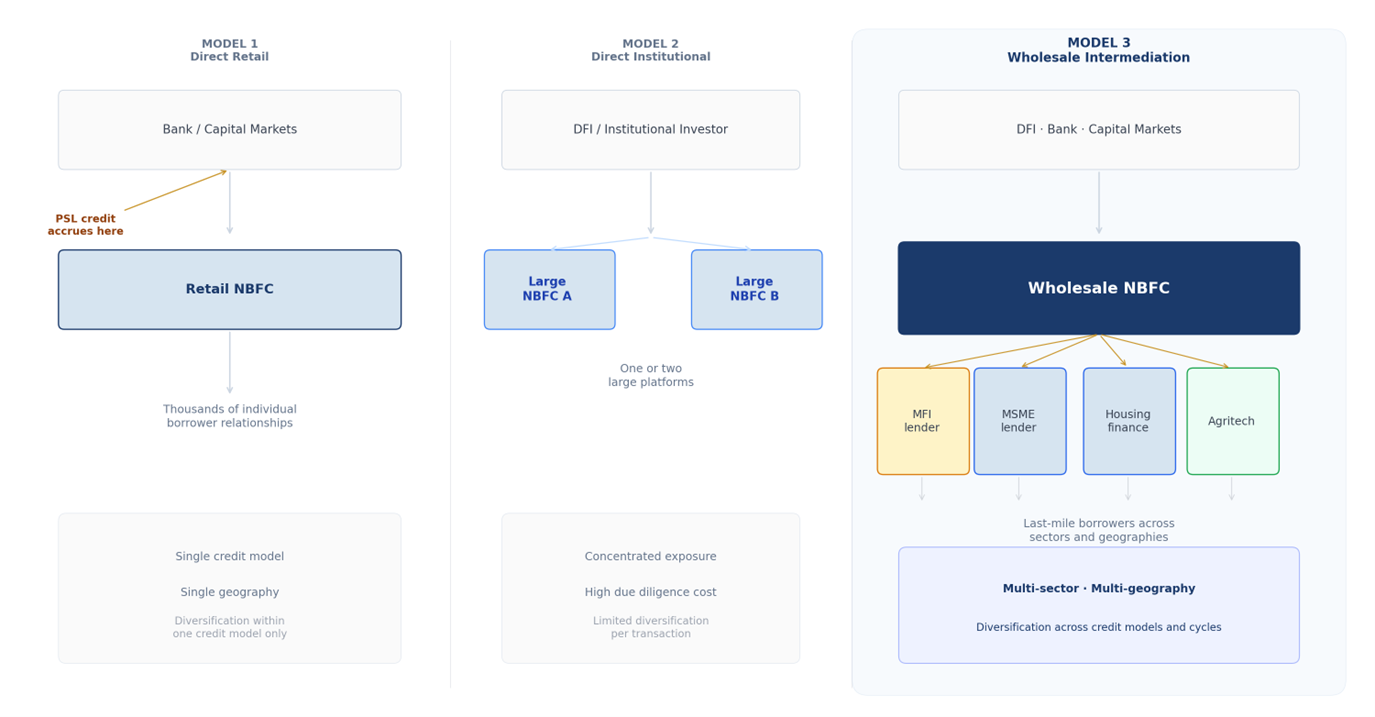
Exhibit 1: The Three Lending Models — Capital Chain and Credit Delivery. Structural illustration. PSL credit classification per RBI Master Directions on Priority Sector Lending 2025, Paras 22–24.
2. THE RETAIL MODEL: WHAT IT DOES AND WHERE IT REACHES ITS LIMITS
Direct retail lending through NBFC-MFIs and similar platforms is the foundation of India’s financial inclusion credit infrastructure. The sector has built over three decades something that did not exist before: a network of regulated institutions with the local knowledge, borrower relationships and community fluency to extend formal credit to borrowers that no centralised institution can serve from a distance. As of March 2025, NBFC-MFIs’ gross loan portfolio stood at approximately ₹3.8 lakh crore, serving 6.5 crore unique active borrowers, according to MFIN Micrometer data [6].
The profitability of the sector, when operating conditions are stable, is real. ICRA reported return on average managed assets of 3.2 – 3.4% for NBFC-MFIs in FY2024, before the sector correction of 2024 to 2025 compressed earnings across the category [8]. That is a creditable return from a lending model that extends credit to borrowers with no collateral, no credit history accessible to mainstream lenders, and incomes that fluctuate with agricultural cycles, monsoon performance and local economic conditions.
The structural constraints of the retail model are visible in the same ICRA data. The sector correction of 2024 to 2025 was severe by historical standards. NBFC-MFI AUM declined by 12%, reversing 29% growth in the prior year [8]. More telling was the asset quality deterioration: overall stress, measured as the sum of SMA, GNPA, write-offs and security receipts, surged to 15.3 percent of the opening book, versus 5.9 percent at March 2024. Provision coverage rose to approximately 4.8 percent of the on-book portfolio. The correction originated in borrower overleveraging and concentrated multi-lender exposure in specific geographies. When collections deteriorated, the impact was concentrated because the model’s geographic and borrower-segment exposure was concentrated. ICRA noted in its FY2025 assessment that NBFC-MFIs were actively managing the ratio of clients per field officer, with staff attrition exceeding 70% in some periods [8]. Retail credit at small ticket sizes scales through people and branches; that is the source of its reach and the limit of its operating leverage.
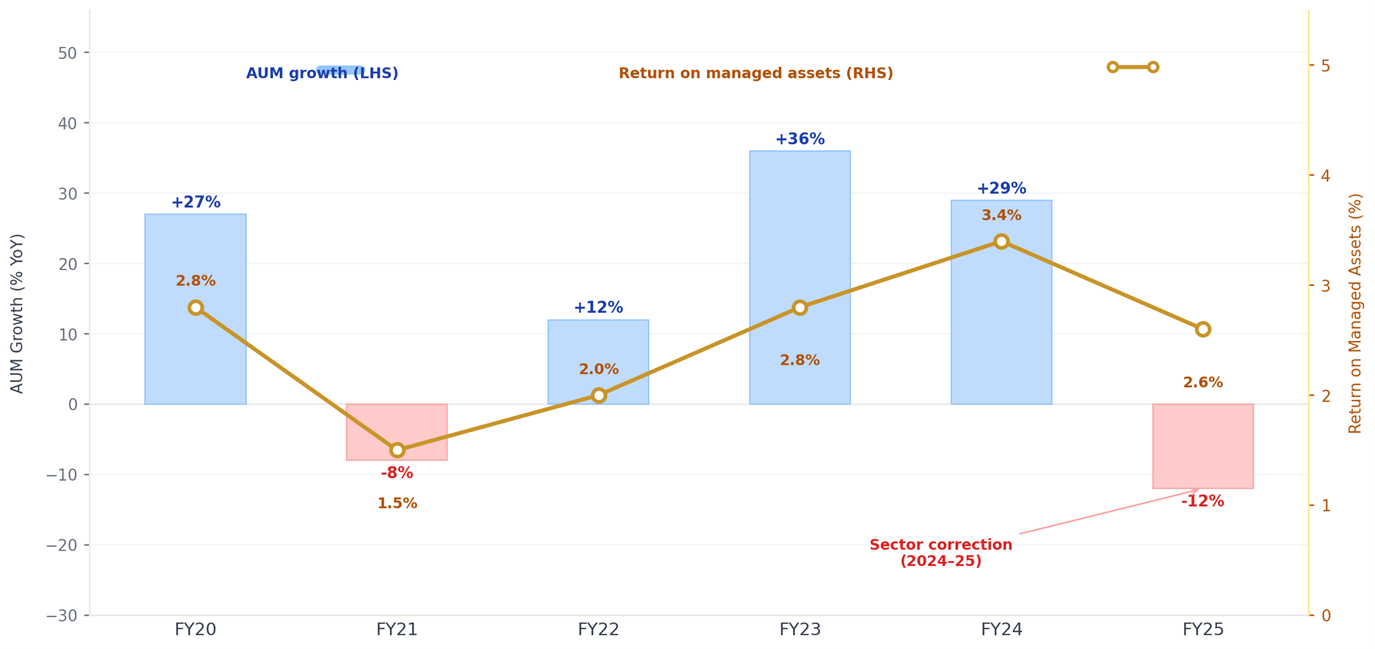
Exhibit 2: NBFC-MFI AUM Growth (YoY %) and Return on Managed Assets (%), FY2020–FY2025. Sources: ICRA NBFC-MFI Sector Reports FY2024 and FY2025. FY2021 AUM growth reflects pandemic disbursement disruption. FY2025 figures reflect ICRA reported actuals and projections as of July 2025.
None of this diminishes the importance of the retail model. It is the mechanism through which formal credit actually reaches the last mile, and no other model replicates its borrower relationship depth or community knowledge. The point is that its scaling characteristics impose constraints on how much institutional capital it can efficiently absorb before operational stretch and geographic concentration produce the kind of asset quality deterioration that the 2024 to 2025 correction illustrated.
3. THE DIRECT INSTITUTIONAL MODEL: REACH WITHOUT GRANULARITY
Development finance institutions, multilateral agencies and sovereign funds occupy a different position in the capital chain. They can deploy patient long-tenor capital at scale, accept returns that reflect developmental objectives alongside commercial ones, and provide the technical assistance and governance support that strengthens platforms over time. The IFC, DEG, FMO, Proparco and the Asian Infrastructure Investment Bank have each increased their India financial inclusion exposure materially over the past five years, and the concessional pricing they offer to qualifying platforms carries real economic value, as examined in an earlier paper in this series.
The direct institutional model’s constraint is the one identified in Paper 2 of this series: the access conditions. DFI due diligence economics set effective minimum ticket sizes. A single DFI facility of USD 20-30 million requires governance assessment, ESG review and impact measurement framework setup that is not recoverable on a facility below a certain size. This creates an effective asset floor for direct DFI engagement that excludes precisely the Tier Two NBFC platforms that most need patient capital.
The direct model also produces limited diversification per transaction. A DFI deploying ₹200 crore directly into a single NBFC has concentrated its India financial inclusion exposure in one institutional credit relationship. Building a diversified exposure across multiple platforms requires multiple transactions, each carrying its own due diligence and monitoring cost. For a DFI with limited India field capacity, the transaction cost of genuine diversification is significant.
The consequence is a selection effect that concentrates concessional institutional capital in the largest, most established platforms, which are also the platforms with the deepest existing access to domestic capital markets. This is not irrational from the perspective of any individual DFI. But in aggregate it means that the segment of the NBFC ecosystem that most needs long-tenor patient capital receives the least of it.
4 .THE WHOLESALE MODEL: THREE SCALING MECHANISMS
The wholesale lending model addresses both constraints simultaneously. It deploys institutional capital through an NBFC that lends to other regulated NBFCs rather than to individual borrowers. That single architectural choice produces three structural advantages that distinguish it from both the retail model and direct institutional deployment.
Diversification through institutional intermediation
A wholesale NBFC lending to thirty regulated counterparties, each of which holds a diversified portfolio of retail borrowers in different geographies and sectors, achieves an effective exposure to the retail credit risk of millions of borrowers. That exposure arrives at the wholesale balance sheet already buffered and aggregated at the institutional level. A default event at a single counterparty is an institutional credit event, not the simultaneous deterioration of thousands of individual borrower relationships. The wholesale lender can assess and manage that risk using the same analytical tools applied to any institutional credit: financial statements, covenant structures, portfolio quality monitoring, and management engagement.
This is not the same diversification that a retail lender achieves by spreading across more borrowers. It is a different risk architecture. The retail lender’s diversification operates within a single model of credit risk: individual borrower income, household cash flow, local economic conditions. The wholesale lender’s diversification operates across models: its thirty counterparties may span microfinance, MSME lending, affordable housing, agritech and e-mobility, each with different demand drivers, different credit cycle sensitivities and different geographic concentrations. When the microfinance sector corrects, an MSME or housing finance counterparty is not necessarily under the same pressure. The cross-sector diversification is not incidental. It is a structural property of the multi-counterparty wholesale model.
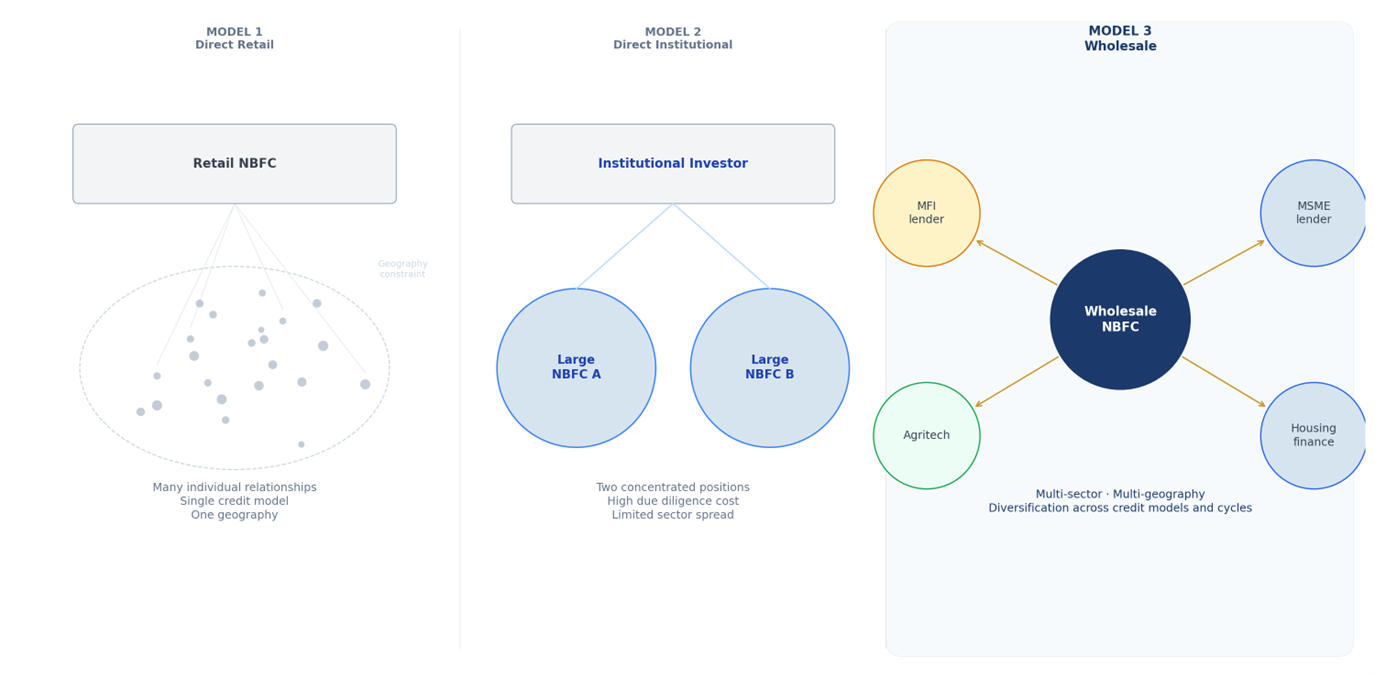
Exhibit 3: Diversification Structure by Lending Model. Structural illustration. Counterparty types are indicative of sector practice. DFI model shown as two platforms for illustration; actual deployment varies.
Specialised underwriting that covers retail risk at institutional scale
The underwriting skill that the wholesale model requires is different from retail credit assessment. A retail credit officer assesses household income, the purpose of the loan, the borrower’s existing obligations and the local economic context. A wholesale credit officer assesses the institution: its governance, its credit culture, the quality and seasoning of its loan portfolio, its funding structure, its management depth, its regulatory standing and its behaviour under previous stress conditions.
This institutional assessment, when well executed, covers the credit risk of the entire retail portfolio the counterparty holds. The wholesale underwriter who assesses a microfinance institution’s portfolio quality, geographic concentration, borrower-level indebtedness management and collection infrastructure is effectively evaluating the credit risk of thousands of individual borrowers, but doing so at the institutional level through observable, auditable metrics rather than through direct borrower interaction. The same analytical capacity that underwrites one institutional counterparty covers more retail credit exposure than a field team of comparable size could directly manage.
The skill is harder to build than retail underwriting. It requires sector expertise, financial analysis capability and relationship depth with institutional counterparties that takes years to develop. But once built, it does not scale proportionately with portfolio size in the way that retail field infrastructure does. The team that underwrites thirty institutional counterparties can, with appropriate monitoring systems, manage a portfolio far larger than a retail credit team of equivalent headcount could directly originate and monitor. What the wholesale model cannot replicate is the retail lender’s direct knowledge of the borrower: the household assessment, the repayment culture, the community relationships that make last-mile credit possible in the first place. The two models are complements, not competitors.
Operating leverage from institutional ticket sizes
The third mechanism is the most straightforward arithmetically. A retail NBFC-MFI extending ₹50,000 average ticket loans to individual borrowers needs approximately 20,000 new loan relationships to grow its portfolio by ₹100 crore. Each of those relationships requires origination, documentation, disbursement and ongoing monitoring. A wholesale NBFC extending ₹25 to 200 crore institutional facilities to regulated NBFC counterparties needs two to four new relationships to achieve the same portfolio growth. The origination, documentation, disbursement and monitoring processes are more complex per transaction, but the transaction volume is orders of magnitude lower.
ICRA’s data on NBFC-MFI profitability illustrates the retail cost structure: return on managed assets of 3.2-3.4% in FY2024, with that figure reflecting the cost of a field-intensive, branch-dependent operating model [8]. The wholesale model does not have comparable published data by model type in public sources, because RBI supervisory data is published by SBR layer rather than by lending model within layers. What can be observed is structural: the absence of branch networks, field staff and retail collection infrastructure in the wholesale model means that operating costs do not grow with the portfolio in the same way.
Funding cost and spread architecture is a key disadvantage in the wholesale NBFC model worth exploring.
The wholesale NBFC operates in the middle of the capital chain, borrowing from banks and capital markets at rates that reflect its own credit standing, and lending to smaller NBFCs at a spread that must cover its operating costs, credit costs and return on equity. This intermediation layer carries an inherent spread cost that direct bank-to-NBFC lending does not. The wholesale model’s economic viability depends on whether its operating cost advantage over direct bank origination to multiple small NBFCs offsets the additional intermediation spread. Where the wholesale platform has genuine sector-specific underwriting depth and a diversified counterparty base, that cost advantage is real and the spread is justified by the institutional work the model performs. Where those conditions are absent, the case for the intermediation layer is weaker and platform-level due diligence should examine the cost trade-off directly.
5 .PSL ATTRIBUTION AND THE WHOLESALE MODEL
India’s Priority Sector Lending framework requires banks to direct 40% of their adjusted net bank credit to designated sectors, including agriculture, MSMEs, housing, education, renewable energy and weaker sections. When a bank cannot efficiently originate these loans directly, it may meet its PSL obligations through on-lending arrangements with NBFCs.
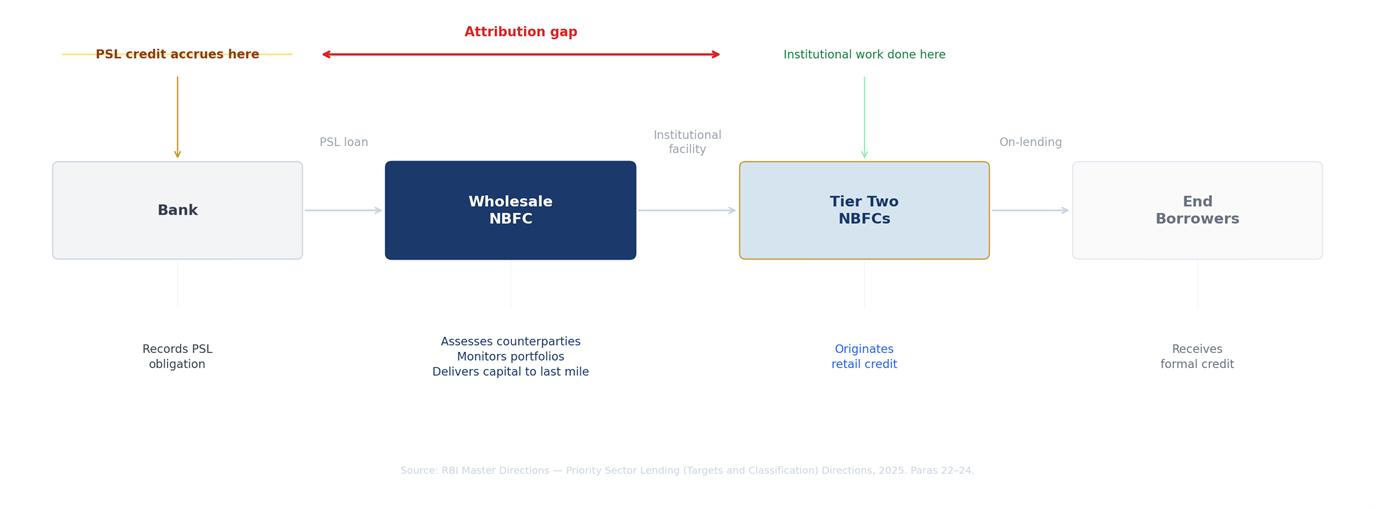
Under the RBI’s Master Directions on Priority Sector Lending, effective April 1, 2025, banks may classify as priority sector their lending to NBFCs, including NBFC-MFIs and other MFIs that are members of an RBI-recognised self-regulatory organisation, for on-lending to eligible priority sectors [1]. The PSL classification accrues to the bank when the NBFC has disbursed the loans to the ultimate borrower and an auditor’s certificate confirms that the same underlying portfolio is not being claimed as PSL by multiple banks simultaneously [1].

Exhibit 4: PSL Credit Chain — Attribution vs. Operational Contribution. Source: RBI Master Directions on Priority Sector Lending (Targets and Classification) Directions, 2025. Structural illustration of PSL classification mechanics under Paras 22–24.
“The PSL framework correctly assigns compliance responsibility to the bank as the regulated entity with the PSL obligation. The wholesale NBFC’s institutional contribution, the counterparty assessment, monitoring and on-lending that connects bank capital to last-mile borrowers, is part of the implementation chain that makes PSL deployment effective. Mapping that contribution precisely matters for understanding how financial inclusion outcomes are produced.”
The mechanics of this arrangement are straightforward and well-established. A bank lends to a wholesale NBFC. The wholesale NBFC lends to a portfolio of smaller NBFC counterparties. Those counterparties extend credit to microfinance borrowers, MSME owners, affordable housing customers and smallholder farmers who would not otherwise have access to formal credit. The bank’s loan to the wholesale NBFC qualifies for PSL classification, provided the end-use conditions are met. The bank records the PSL achievement. The wholesale NBFC records a liability.
What the PSL framework measures is credit outcomes at the point of bank deployment, which is the appropriate compliance point for a bank-facing regulatory instrument. The wholesale NBFC that assesses the creditworthiness of smaller NBFC counterparties, monitors their portfolio quality, structures the terms of the lending relationship and provides the institutional capital that allows them to lend to borrowers they would not otherwise reach is not the regulated entity with the PSL obligation. That work is nonetheless the mechanism through which the bank’s PSL capital reaches its intended beneficiaries. Understanding this distinction helps investors and policymakers map the full institutional contribution of each actor in the chain more precisely.
This asymmetry is not a regulatory error. The PSL framework measures credit outcomes at the point of bank deployment, not at the point of ultimate borrower impact. The bank is the regulated entity with the PSL obligation, and it is appropriate that the bank bears the compliance responsibility. What the framework does not measure is the institutional contribution of the intermediaries through whom that compliance is achieved. A bank that lends directly to a microfinance borrower through its own branch network and a bank that lends to a wholesale NBFC that lends to ten smaller NBFCs that collectively serve a hundred thousand microfinance borrowers receive the same PSL credit per rupee. The complexity, the institutional development work and the last-mile reach generated by the second arrangement are not reflected in the measurement.
This observation is not an argument for regulatory change. It is an analytical observation about how the wholesale model’s contribution to financial inclusion is currently measured, and therefore how it tends to be characterised in policy discussions. An investor or policymaker relying on PSL data alone to assess the role of different institutional actors in credit delivery will undercount the contribution of wholesale intermediaries. The credit gap this series has documented in earlier papers is not primarily a gap in bank PSL compliance. It is a gap in the institutional infrastructure that connects bank capital to last-mile borrowers. Wholesale NBFCs sit at the centre of that infrastructure.
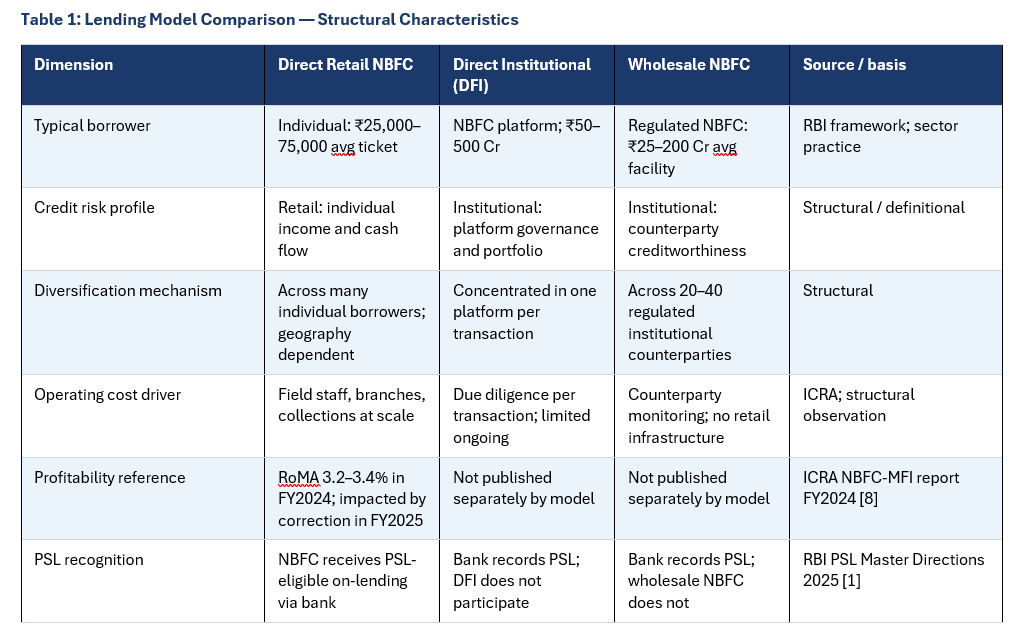
6 .THE THREE MODELS COMPARED
The table below sets out the three lending models across six observable dimensions. The data where cited reflects published sources; where the characterisation is structural rather than quantitative, it is described as such. The table is not intended as a ranking. Each model serves a function in the credit chain. The purpose is to make the structural differences visible.

Sources: ICRA NBFC-MFI Sector Reports [8]; RBI Priority Sector Lending Master Directions 2025 [1]; RBI SBR framework. Retail ticket size reflects MFIN data on average loan size. Wholesale facility size is indicative based on disclosed transaction data and sector practice. Profitability data for direct institutional and wholesale models is not published separately in public sources by lending model type. Characterisations marked as structural or definitional reflect the inherent design of each model rather than cited empirical data.
Several observations follow from the comparison. The diversification produced by the wholesale model is qualitatively different from retail diversification. A retail NBFC with a portfolio spread across 100,000 borrowers has granular diversification within a single credit model. A wholesale NBFC with thirty institutional counterparties spanning five sectors has diversification across credit models and credit cycles, which is a more resilient risk architecture under systemic stress.
The operating cost driver for each model also follows from the architecture. The retail model’s operating costs scale with the portfolio because origination, monitoring and collections are people-intensive and cannot be centralised without losing the local knowledge that makes the model work. The wholesale model’s operating costs grow more slowly because the critical work is institutional analysis rather than field-level borrower management. ICRA’s observation that NBFC-MFIs were managing the ratio of assets per field officer, and that staff attrition exceeded 70 percent in stress periods, is a concrete illustration of the operational intensity that the retail model requires [8]. The wholesale model faces different operational challenges, but they are analytical rather than logistical.
7 .THE CONDITIONS THAT DETERMINE WHETHER THE MODEL DELIVERS
The structural advantages described in the previous sections are properties of the wholesale model’s architecture. They are not automatic. A wholesale NBFC that concentrates its counterparty exposure in three platforms, all operating in the same sector and geography, does not produce the cross-sector diversification the model is theoretically capable of. A wholesale lender whose underwriting is generic rather than sector-specific does not cover the credit risk of its counterparties’ portfolios more efficiently than a retail lender would. Operating leverage only materialises if the monitoring infrastructure is adequate; without it, counterparty credit events arrive without warning.
Three conditions determine whether the model’s theoretical scaling advantages translate into observed performance.
Genuine counterparty diversification
Diversification that is nominal rather than genuine, a portfolio of fifteen counterparties all concentrated in NBFC-MFI lending in two states, for example, does not produce the cross-cycle resilience that the wholesale model’s architecture can provide. Genuine diversification requires segment-specific underwriting infrastructure for each category of counterparty, so that the wholesale lender can assess an e-mobility platform using metrics appropriate to that sector rather than applying a microfinance template to a business with fundamentally different credit dynamics. No single segment should dominate the portfolio to a degree that creates sector correlation risk across counterparties simultaneously.
Institutional underwriting depth
The claim that wholesale underwriting covers retail credit risk efficiently depends on the quality of that underwriting. An institutional assessment that is superficial, that reviews financials without examining portfolio quality at the borrower segment level, or that does not probe management depth and governance culture, will miss the early indicators of counterparty stress that give a wholesale lender time to act. The 2024 to 2025 microfinance correction produced visible signals in portfolio-at-risk data and borrower-level indebtedness metrics before it produced reported NPAs. A wholesale lender with genuine sector-specific underwriting capability would be monitoring those signals across its counterparty portfolio on an ongoing basis.
Capital adequacy as cycle management
A wholesale NBFC that is thinly capitalised relative to its regulatory minimum cannot grow through credit cycle dislocations, when counterparty stress creates opportunities for well-capitalised platforms to deepen relationships and deploy capital at better terms. Capital adequacy is not just a regulatory requirement in the wholesale model. It is the mechanism through which the platform can behave counter-cyclically: maintaining or increasing commitment to counterparties under temporary stress rather than withdrawing, which is when the intermediation function is most valuable. Platforms with Tier 1 capital adequacy ratios materially above the regulatory minimum have more flexibility to absorb counterparty volatility without triggering their own funding constraints.
8 .THE RISKS THAT ARE STRUCTURAL TO THE MODEL
Intellectual honesty requires naming the risks that are inherent to the wholesale model alongside its advantages. Three are structural.
Counterparty concentration risk operates differently in the wholesale model than in retail. A retail lender with a stressed loan book has a large number of small deteriorating positions. A wholesale lender with a stressed counterparty has a concentrated institutional credit event: a single large exposure whose deterioration may be correlated with deterioration in that counterparty’s own retail portfolio. The buffering that the wholesale architecture provides in normal conditions can amplify concentration risk in stress, particularly if the wholesale lender has not maintained genuine diversification across sectors and geographies.
Sector correlation risk is the second structural exposure. The wholesale model’s multi-sector diversification provides resilience when different sectors move on different cycles. It provides less protection when a systemic shock, a pandemic, a severe credit tightening, a broad regulatory intervention, affects multiple sectors simultaneously. The 2020 moratorium period compressed credit availability across retail, MSME and microfinance simultaneously, and wholesale lenders with exposure across those sectors did not have the cross-sector buffer that normal-period diversification would suggest.
Management concentration is the third. The platform’s counterparty relationships, credit committee judgment, regulatory credibility and funder confidence are often substantially concentrated in the founder or a team of two to three senior leaders. A loss of key personnel is not a marginal operational event; it can trigger counterparty relationship reviews, funder re-assessments and rating agency watch-listings simultaneously. An investor should assess the depth of the second leadership tier and the existence of formalised credit committee processes that do not depend on any single individual’s participation.
CONCLUSION
The three lending models examined in this paper are not competing for the same function. Direct retail lending builds the last-mile credit infrastructure that no other model can replicate. Direct institutional deployment provides the long-tenor, concessional capital that well-governed large platforms need to sustain their funding advantage. Wholesale intermediation connects institutional capital to the platforms that cannot access it directly, doing so at an operating cost structure that the retail model cannot match and with a risk architecture that individual direct institutional transactions cannot produce.
The wholesale model scales differently because its architecture is different. Institutional counterparties rather than individual borrowers, analytical underwriting rather than field-level credit assessment, diversification across credit models rather than across individual positions. These are structural properties that persist as the portfolio grows, not managerial achievements that erode at scale.
Wholesale intermediation allows institutional capital to reach the smaller platforms that cannot access it directly — which is precisely the funding trap identified in the second paper of this series. The wholesale model does not solve that trap through better pricing alone. It solves it through a different institutional architecture: one that converts large-ticket institutional capital into the small-ticket counterparty facilities that Tier Two platforms need, at an operating cost structure that retail delivery cannot match. Where the conditions for that architecture are present (genuine counterparty diversification, sector-specific underwriting depth and adequate capital buffers through the cycle) the model closes the gap. Where they are absent, the structural advantages do not materialise. That is where platform-level due diligence begins.
REFERENCES AND DATA SOURCES
Regulatory Sources
- [1] Reserve Bank of India. (2025). Master Directions — Reserve Bank of India (Priority Sector Lending – Targets and Classification) Directions, 2025. FIDD.CO.PSD.BC.13/04.09.001/2024-25. March 24, 2025, effective April 1, 2025. Department of Financial Inclusion and Development, RBI, Mumbai. Paras 22, 23 and 24 govern bank lending to NBFCs and MFIs for PSL on-lending purposes.
- [2] Reserve Bank of India. (2026). FAQs on Priority Sector Lending (PSL). Updated January 22, 2026. RBI, Mumbai. Clarifies PSL classification methodology for on-lending through NBFCs and MFIs.
- [3] Reserve Bank of India. (2025). Reserve Bank of India (Non-Banking Financial Companies – Scale Based Regulation) Directions, 2023. October 19, 2023 (updated 2025). Department of Regulation, Mumbai.
Sector Reports
- [4] Reserve Bank of India. (2025). Report on Trend and Progress of Banking in India 2023–24. December 26, 2024. RBI, Mumbai. Chapter VI covers NBFC sector performance including GNPA ratios and credit growth.
- [5] Reserve Bank of India. (2025). Report on Trend and Progress of Banking in India 2024–25. December 2025. RBI, Mumbai. Reports NBFC credit-to-GDP at 14.6% in FY25; loans and advances growth of 19.4% at end-March 2025.
- [6] Microfinance Institutions Network. (2025). Micrometer: Quarterly Microfinance Sector Report, Q4 FY2025. MFIN, New Delhi. Reports 6.5 crore unique active borrowers and GLP data as of March 2025.
- [7] Sa-Dhan. (2025). The Bharat Microfinance Report 2025. Sa-Dhan, New Delhi.
- [8] ICRA Limited. (2024, 2025). Non-Banking Financial Companies – Microfinance Institutions: Sector Reports, FY2024 and FY2025. ICRA Limited, Mumbai. Reports RoMA of 3.2–3.4% in FY2024; AUM decline of 12% in FY2025; staff attrition data; managed gearing data.
- [9] ICRA Limited. (2025). Medium and Small NBFCs: Sector Performance Assessment, March 2025. ICRA Limited, Mumbai.
- [10] CRISIL MI&A. (2025). India NBFC Sector Analysis, FY2025. CRISIL Market Intelligence and Analytics, Mumbai.
Arete Research
- [11] Arete Financial Partners. (2026). India Impact Credit Sector Model: Addressable Market Projections 2025–2030. Internal research document. Arete Financial Partners, Singapore.
METHODOLOGY NOTE
This paper draws on three categories of data. First, RBI regulatory framework data: the PSL mechanics described in Section V are sourced directly from the RBI Master Directions on Priority Sector Lending 2025 [1] and the accompanying FAQ updated January 2026 [2]. Second, NBFC sector profitability and asset quality data: the NBFC-MFI return on managed assets figures are from ICRA’s NBFC-MFI sector reports [8], which cover entities reporting to RBI as NBFC-MFIs. Third, structural characterisations: arguments about operating cost structure, diversification mechanics and underwriting requirements are presented as structural observations about each lending model’s design rather than as empirically measured data points, because operating cost ratios by lending model type are not published separately in public RBI or rating agency sources. Table 1 identifies each row’s basis (cited source, sector practice, or structural) to make this distinction visible to the reader. No forward return projections are made in this paper. Past sector performance data is presented as historical observation, not as an indication of future results.
DISCLAIMER
This paper has been prepared by Arete Financial Partners for informational and research purposes only and does not constitute investment advice, a solicitation to purchase or sell any securities or financial instruments, or an offer of any kind. Information contained herein has been obtained from sources believed to be reliable, but Arete Financial Partners makes no representation as to its accuracy or completeness. Past performance data is presented for informational purposes and does not indicate future results. This document is intended for sophisticated institutional readers. Redistribution requires the prior written consent of Arete Financial Partners. Copyright 2026, Arete Financial Partners. All rights reserved.