
The Funding Trap: How NBFC Funding Markets Bifurcated and Why It Matters for Borrowers
An analysis of capital structure divergence in India’s non-banking financial sector and its consequences for credit access in underserved markets
ABSTRACT
KEY FINDINGS
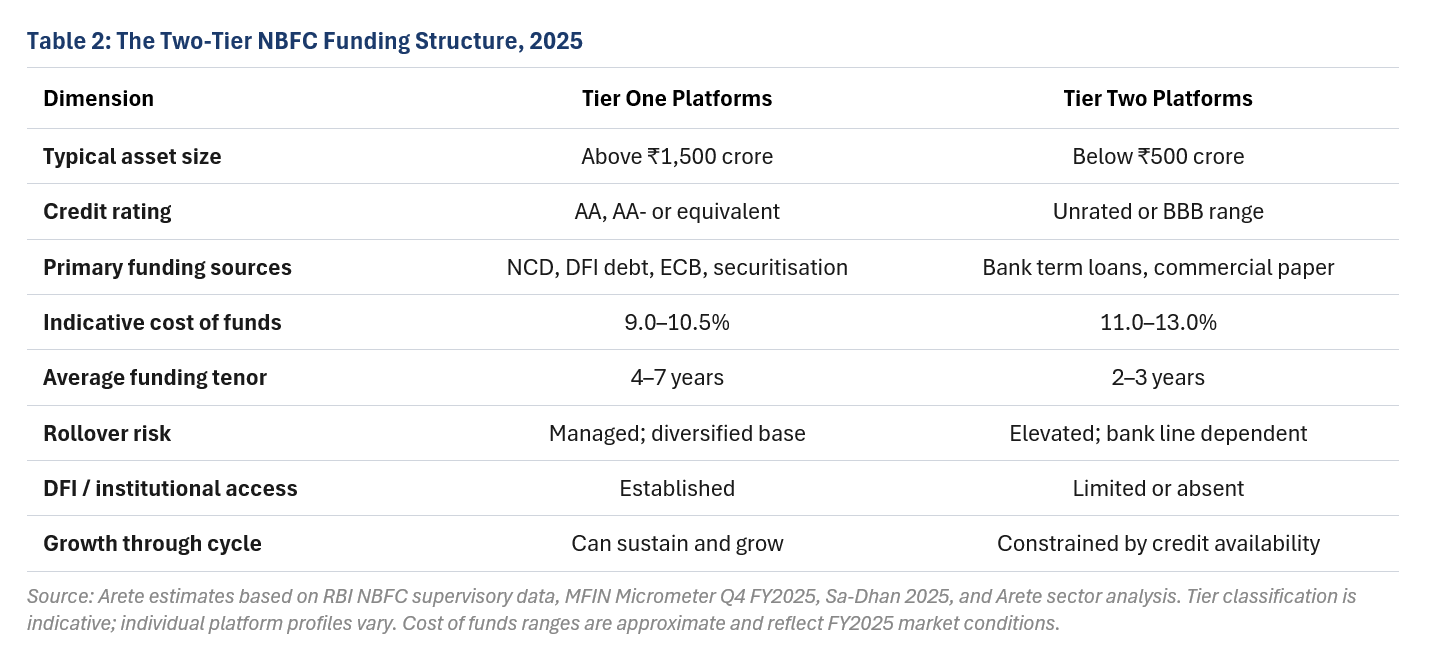
- India’s NBFC sector has bifurcated into two distinct funding tiers since 2018: Tier One platforms (₹1,500+ Cr) access DFI debt, domestic capital markets and external commercial borrowings at 9–10.5%, while Tier Two platforms (below ₹500 Cr) rely on bank term loans priced at 11–13%, a differential of 200 to 300 basis points.
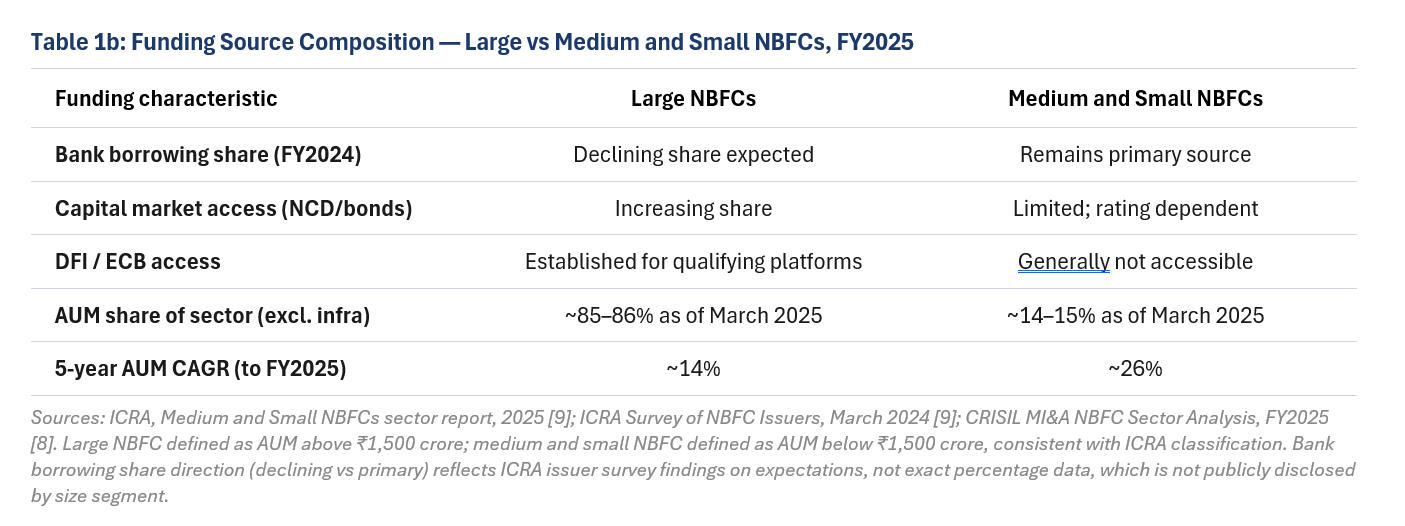
- Medium and small NBFCs (AUM below ₹1,500 Cr) represent 14-15% of sector assets but are growing at 26% annually, significantly faster than larger peers at 14%, indicating supply constraint rather than demand limitation.
- How the funding trap operates: an NBFC with ₹300 Cr in assets, sound credit fundamentals and 3-year consecutive profitability cannot access DFI debt (minimum ticket ₹125–250 Cr, floor ₹500–750 Cr), cannot issue NCDs (rating gap), and cannot securitise (seasoning gap), leaving it trapped in short-tenor, high-cost bank debt renewable every 2-3 years.
- Higher funding costs pass directly to borrowers: a farmer borrowing at 22% from a Tier Two NBFC faces higher repayment stress than a comparably creditworthy borrower at 19.5% from a Tier One platform, despite identical underlying credit risk.
- Smaller NBFC-MFIs reported PAR30+ at 8.1% in FY25 v/s lower rates at larger peers, reflecting the self-reinforcing cycle: higher funding costs compress margins, reducing portfolio capacity, which sustains the higher-risk perception that justifies the cost differential.
Keywords: NBFC funding markets, development finance institutions, cost of funds, funding trap, India, credit access, non-banking financial companies, DFI debt, capital markets, financial inclusion, wholesale lending, ECB, securitisation
1. FROM BANK DEPENDENCY TO A DIFFERENTIATED MARKET
In September 2018, Infrastructure Leasing and Financial Services (IL&FS) defaulted on its commercial paper obligations. What followed was not simply a credit event. It was a demonstration of how comprehensively India’s non-banking financial sector had concentrated its funding in a single, fragile channel. NBFCs had borrowed short through commercial paper and bank lines, lent long into infrastructure, housing and small enterprise credit, and built balance sheets whose apparent stability depended on the continuous rollover of short-tenor debt. When that rollover stopped, the sector contracted sharply. A decisive regulatory and policy response, including RBI liquidity support measures and enhanced supervisory engagement, prevented the episode from becoming a systemic disruption and created the conditions for the sector’s subsequent restructuring.
The IL&FS episode was the stress test that revealed the architecture. The question it posed to every NBFC board and every investor in the sector was the same: what does a resilient funding structure actually look like, and how do you build one when the funding market itself is in retrenchment?
The answer that emerged over the following five years was not the same for every platform. Well-capitalised platforms with strong credit ratings and established governance frameworks used the restructuring period to diversify, accessing non-convertible debenture markets, negotiating external commercial borrowings with development finance institutions, and building securitisation programmes that offered investors rated tranches of their loan book. Platforms at an earlier stage of institutional development faced a longer path: the alternative funding channels that larger peers were developing required scale, rating and governance infrastructure that takes time to build, and that time is the central challenge the funding trap describes.
By 2024, the sector that had looked broadly uniform in its bank dependency in 2017 had sorted itself into two distinct funding tiers. The sorting was not arbitrary. It tracked, with considerable precision, the size, rating, governance quality and institutional maturity of the platforms involved. That precision is what makes the bifurcation analytically interesting rather than merely descriptive.
2. WHAT TIER ONE PLATFORMS CAN NOW ACCESS
Funding options available to a well-governed NBFC with assets above roughly ₹1,500 crore, an investment-grade credit rating and an established track record through at least one credit cycle are materially different from what was available to any NBFC ten years ago. The ₹1,500 crore threshold is a useful analytical boundary but not a universal one. In microfinance and small-ticket MSME lending, platforms with AUM of ₹500-1,000 crore may already be operationally mature and well-governed, yet fall below the scale at which DFI or NCD access becomes viable. In vehicle finance or housing finance, ₹1,500 crore may represent a relatively early-stage platform. The funding trap operates at different asset size thresholds depending on the lending segment, and a single cutoff necessarily oversimplifies. This paper uses the ICRA classification for consistency with published data [10], while acknowledging that the effective floor for institutional capital access varies by product and geography. Three channels have opened / deepened significantly:
Development finance institution debt
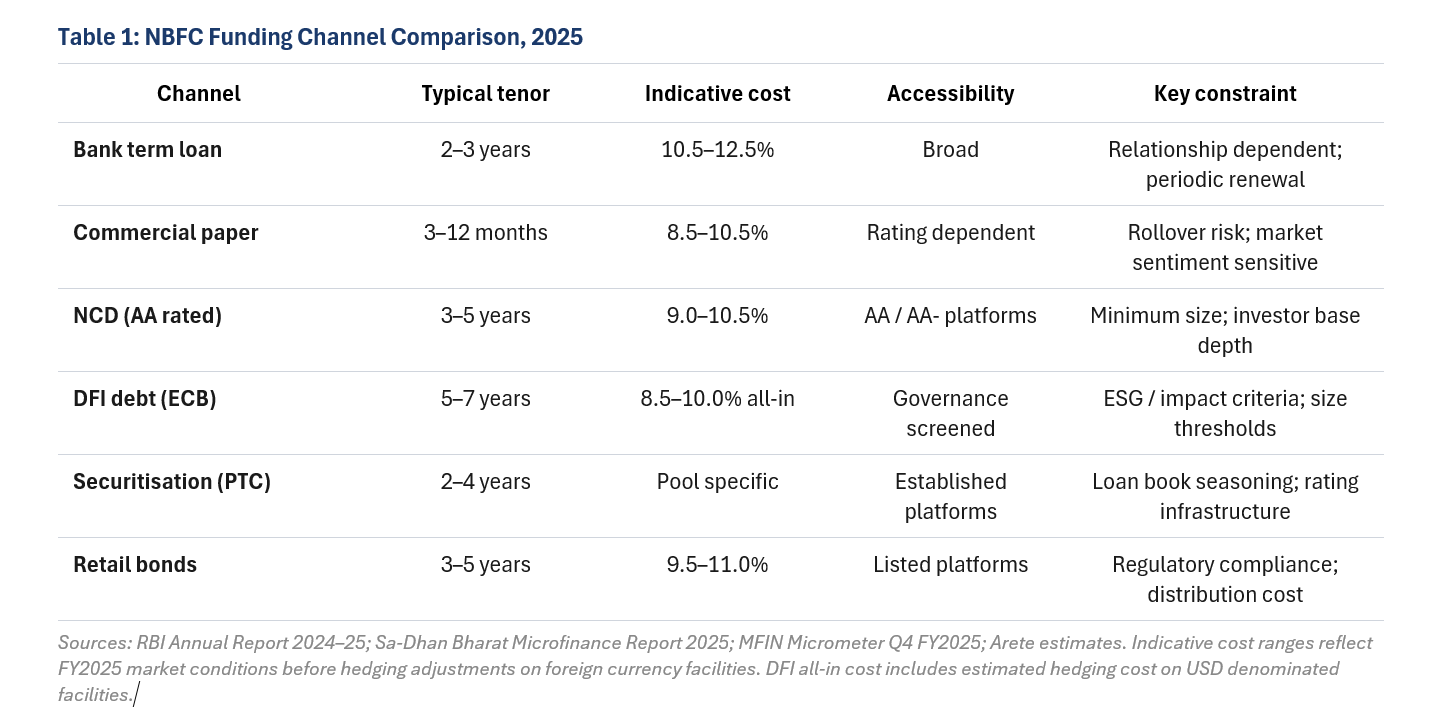
The IFC, DEG, FMO, Proparco, the Asian Infrastructure Investment Bank and several bilateral development lenders have increased their India financial inclusion exposure substantially since 2018. For NBFC counterparties that meet their eligibility criteria, DFI debt carries two advantages beyond the headline rate. Tenor is typically five to seven years, significantly longer than the two to three year domestic bank term loan that remains the default for most platforms. And pricing, after accounting for hedging costs on foreign currency denominated facilities, typically runs 50 to 150 basis points below comparable domestic term loan rates in periods when the USD/INR forward premium is moderate; in periods of elevated forward costs the advantage narrows and can be eliminated. That spread is not trivial at the scale of an NBFC balance sheet. On a ₹500 crore DFI facility, a 100 basis point cost advantage over a domestic term loan represents ₹5 crore of annual interest saving that either flows to lending margin or is passed through to borrowers as lower rates.
The eligibility criteria are the constraint. DFI lenders typically require environmental, social and governance assessment, impact measurement frameworks aligned with recognised international standards, board-level governance structures that can withstand external scrutiny, and credit standards that most sub-₹500 crore platforms have not yet fully built. Access is conditional on institutional maturity, not just credit quality. That conditionality is deliberate. It creates a selection effect that concentrates concessional long-tenor capital in platforms that have demonstrated the capacity to deploy it responsibly.
Domestic capital markets
The non-convertible debenture market has deepened considerably as an NBFC funding channel since 2019. Rated NCD issuances by established NBFC platforms now attract insurance companies, pension funds, mutual funds and corporate treasuries seeking credit exposure above the sovereign curve. For platforms with AA or AA minus ratings, the market is liquid and pricing is competitive. The development is significant because NCD funding, unlike bank term loans, is not subject to the relationship dynamics and periodic renegotiation that make bank credit management operationally intensive. A five year NCD at a fixed spread provides funding visibility that a bank term loan renewed annually does not.
Retail bond issuances have also become viable for a subset of platforms. Several NBFC-MFIs and housing finance companies have placed bonds directly with retail investors through the BSE and NSE platforms, diversifying their funding base beyond the institutional investor community. The volumes remain modest relative to total funding requirements, but the channel matters because it demonstrates public market access, which in turn supports credit rating stability and institutional investor confidence.
External commercial borrowings
ECB access has expanded for NBFCs in eligible end-use categories, including affordable housing, microfinance and renewable energy lending. For platforms that qualify, the all-in cost after hedging has been competitive with domestic alternatives in periods of favourable forward curve conditions. More importantly, ECB facilities from DFI lenders frequently carry technical assistance components and covenant structures that help platforms build the institutional infrastructure that sustains their rating and their access to further capital. The ECB channel is therefore not purely a funding transaction. For many platforms it has been an institutional development relationship as much as a liability management exercise.
The chart below, drawn from RBI NBFC return submissions compiled by Sa-Dhan, illustrates the compositional shift in NBFC-MFI funding sources between 2015 and 2025. Bank borrowings, which constituted the dominant share of funding in the earlier period, have been displaced progressively by NCD issuances, securitisation and external borrowings. The shift is not uniform across the sector. It reflects the growing weight of larger, better-rated platforms whose funding diversification pulls the aggregate composition. For smaller platforms the picture is different, and that difference is the subject of the following section.
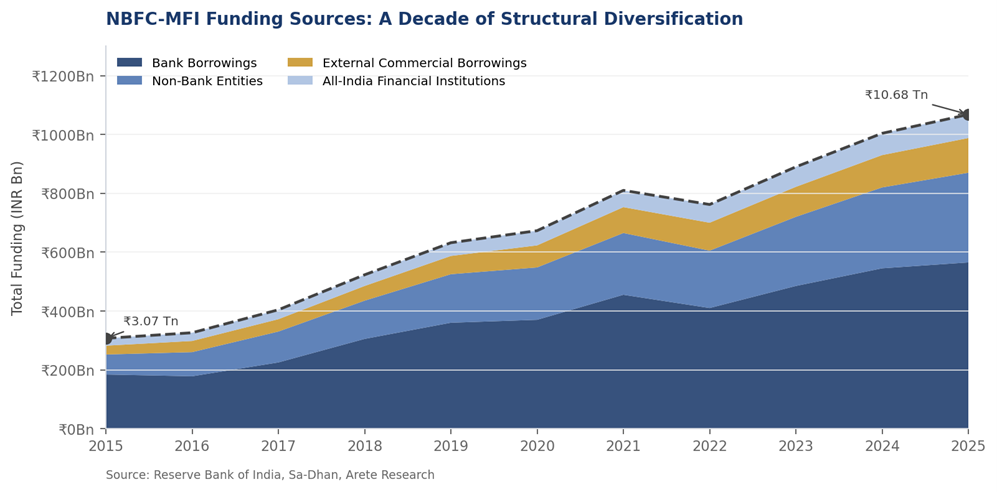
Exhibit 1: NBFC-MFI Funding Sources, Composition and Growth, 2015 to 2025 (INR Billion). Source: RBI NBFC return submissions as compiled by Sa-Dhan Annual Bharat Microfinance Report 2025. Data covers NBFC-MFI entities reporting to the RBI and reflects the MFI segment; it does not capture the full NBFC universe.
3. THE FUNDING TRAP
“The funding trap is the condition in which a creditworthy NBFC cannot access institutional capital because it has not yet crossed the scale and governance thresholds that institutional lenders require, and cannot cross those thresholds without the capital it cannot access.”
The platforms that benefited most from the post-2018 funding diversification were, without exception, those that were already large enough, well-rated enough and institutionally mature enough to meet the entry requirements of the new channels. That is not a criticism of how those channels were designed. DFI lenders cannot extend long-tenor, below-market debt to platforms whose governance they cannot assess. NCD markets cannot price credit they cannot rate. The conditionality is rational from each capital provider’s perspective.
Individually rational conditionality creates a market structure where the platforms most capable of using lower-cost, longer-tenor capital to serve underserved borrowers efficiently are precisely the ones that already have it, while the platforms closest to those borrowers in geography and relationship terms remain trapped in the short-tenor, high-cost funding that constrains their growth and lending terms.
The trap has a specific mechanism. A regulated NBFC with assets of ₹300 crore, a sound loan book and three years of consecutive profitability cannot access DFI debt because its asset size falls below the minimum ticket size that makes DFI due diligence economically viable. It cannot issue NCDs because it lacks rating infrastructure and investor relationships that NCD placement requires. It cannot securitise at scale because its loan book lacks the seasoning and standardisation that rating agencies require for investment-grade structured credit. It therefore remains on bank term loans at 11 to 12.5 percent, renewing them every two to three years, managing its growth trajectory around bank credit availability rather than borrower demand availability.
Growing out requires capital the platform cannot access until it has grown. The circularity is the defining feature of the trap. Platforms that escape it typically do so through one of three routes: a strategic equity investor who provides the capital injection that crosses the rating threshold; a DFI that grows an early-stage relationship as the platform matures; or a wholesale NBFC counterparty whose lending provides the liability that helps the borrowing NBFC build balance sheet scale. Each route depends on a relationship, a judgment call by a capital provider that the platform is worth backing before the metrics fully justify it. The opportunity for the next phase of sector development lies in making those relationships more systematic, extending the benefits of institutional capital access to a broader set of platforms through structured mechanisms that complement what the market generates on its own.
4 .THE COST-PASS-THROUGH AND ITS CONSEQUENCES FOR BORROWERS
The funding trap does not remain on the NBFC balance sheet. It moves downstream. A Tier Two NBFC operating at a materially higher cost of funds than a Tier One peer cannot price its loans equivalently and remain viable. The cost difference passes through, in whole or in substantial part, to the borrower. The borrower who takes a loan from a Tier Two NBFC is likely to pay more than a borrower of comparable creditworthiness served by a Tier One platform, to a degree that reflects the difference in funding cost between the two institutions.
That differential is not a reflection of borrower risk. The smallholder farmer in Rajasthan served by a small regional NBFC and the smallholder farmer in Maharashtra served by a large, DFI-funded NBFC-MFI present broadly similar credit profiles. Their repayment capacity is determined by the same agricultural income dynamics, the same household expenditure pressures and the same weather-dependent cash flows. What differs is the funding architecture of the institution lending to them, and the geographic and institutional accident of which one happens to be in their district.
The consequence of paying 250 basis points more on a working capital loan is not merely a reduction in the borrower’s net income from the loan proceeds. At small ticket sizes, the absolute rupee cost difference is modest but the proportional impact on household cash flow is not. A ₹50,000 microfinance loan at 22 percent annual interest carries a weekly instalment materially higher than the same loan at 19.5 percent. For a household operating on thin margins, that difference can determine whether the loan is sustainable or whether a single income disruption, an illness, a failed crop, a delayed payment from a buyer, pushes the borrower into arrears.
Higher borrowing costs on already marginal household budgets increase the probability of stress. Default rates in portfolios of higher-cost lenders are therefore structurally elevated relative to portfolios of lower-cost lenders serving comparable borrower populations. Those higher default rates do not go unobserved by the bank credit officers who review term loan applications from Tier Two NBFCs. They reinforce the perception that small NBFC lending carries inherently higher credit risk, which justifies the pricing and collateral conditions that the bank imposes, which sustains the higher cost of funds that produces the default experience in the first place.
“The borrower who takes a loan from a Tier Two NBFC is likely to pay more than a borrower of comparable creditworthiness served by a Tier One platform. That difference is not a reflection of borrower risk. Closing it is the central challenge and the central opportunity for the next phase of India’s financial inclusion agenda.”
The cycle is self-reinforcing and it operates in both directions. When credit conditions tighten, as they did in 2018 to 2019 and again during the MFI sector correction of 2024 to 2025 [6][7], Tier Two platforms face disproportionate funding pressure. Commercial paper markets price in sector sentiment broadly, without always distinguishing between well-run and poorly-run platforms, because the rating and track record infrastructure that enables that distinction takes time to build. Platforms serving geographically remote or financially excluded borrowers are therefore most exposed to funding volatility, which is precisely why building institutional resilience in those platforms is an important policy and market objective. The borrowers in these segments benefit the most when the platforms serving them can sustain access through periods of market stress.
This is not a cyclical problem that corrects itself automatically when credit conditions improve. When conditions improve, Tier One platforms benefit first and most, deepening the funding advantage that the stress period has already widened. Tier Two platforms recover more slowly, and the sector correction of 2024 to 2025 has produced a consolidation dynamic in which some smaller platforms are ceding market share to larger ones. That consolidation is not inherently bad for borrowers if the acquiring platform serves them at lower cost. It does, however, reinforce the importance of maintaining a diverse institutional ecosystem. India’s financial inclusion agenda has been built on the strength of platforms with deep geographic reach and sector-specific expertise, and preserving that diversity alongside scale is the defining challenge for the sector’s next phase.
The scale of the trapped segment
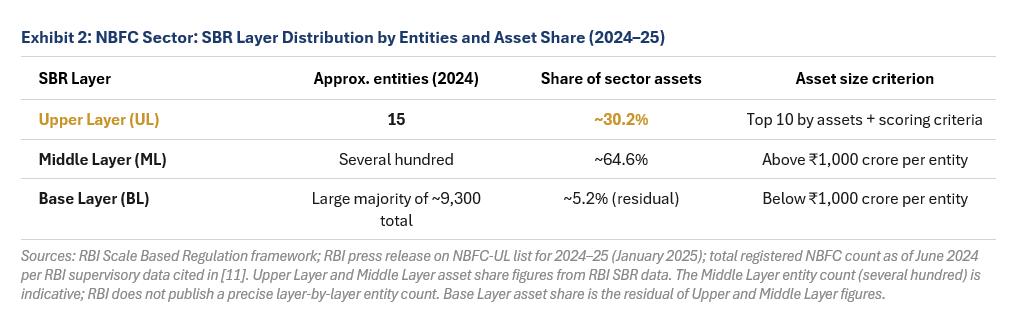
The RBI’s Scale Based Regulation framework provides the clearest available proxy for the size of the trapped segment. As of June 2024, approximately 9,300 NBFCs were registered with the Reserve Bank [11]. Of these, 15 were classified in the Upper Layer for 2024–25, identified by the RBI as warranting enhanced regulatory oversight based on size and a scoring methodology. The Upper Layer entities collectively account for approximately 30.2 percent of total NBFC sector assets. The Middle Layer, comprising deposit-taking NBFCs of all sizes and non-deposit-taking NBFCs with assets above ₹1,000 crore per entity, accounts for approximately 64.6 percent of sector assets. The Base Layer, consisting of non-deposit-taking NBFCs with assets below ₹1,000 crore, contains the large majority of registered entities by number but a residual share of total assets [5].
ICRA’s assessment of medium and small NBFCs, defined as those with AUM below ₹1,500 crore, found that this segment accounted for approximately 14 to 15 percent of total NBFC sector AUM as of March 2025, despite growing at a five-year compound annual rate of approximately 26 percent, materially faster than the 14 percent recorded by larger peers over the same period [10]. This combination, faster loan book growth alongside a funding base that does not diversify in the way larger platforms can, is consistent with the dynamic the funding trap describes. ICRA’s 2024 survey of NBFC issuers found that larger entities expected bank funding to decline as a share of their mix, while smaller peers expected bank borrowings to remain their primary funding source [10]. The divergence is not new, but the data suggest it is not narrowing.
The table below sets out the SBR layer distribution. The figures are drawn from RBI supervisory data and illustrate the structural asymmetry: 15 Upper Layer entities account for nearly a third of all NBFC sector assets, while the large majority of registered NBFCs by number sit in the Base Layer, below the asset thresholds at which institutional capital markets become accessible.
Asset quality divergence by lender size
India’s NBFC sector demonstrated considerable overall resilience through the FY2025 microfinance correction, reflecting the stronger funding and governance foundations built since 2018. Within that broader resilience, however, the stress was not evenly distributed. MFIN data for Q4 FY2025 shows PAR30+ at 8.1% for smaller NBFC-MFIs, compared to materially lower levels reported by larger NBFC-MFIs that benefited from diversified funding, stronger collection infrastructure, and the capacity to manage stressed portfolios more actively. This pattern is consistent with the feedback loop described above: platforms operating at higher cost of funds and thinner margins have less capacity to absorb stress, which reinforces the case for extending institutional funding access further down the size distribution.
5 .WHAT DETERMINES ACCESS TO INSTITUTIONAL CAPITAL
Understanding the funding trap requires understanding precisely what conditions a platform must satisfy before institutional capital becomes accessible. The conditions are not arbitrary. They reflect the due diligence economics and risk management requirements of institutional lenders operating in a market where information about small NBFC platforms is expensive to obtain and credit events are difficult to recover from.
Asset size and minimum ticket economics
DFI lenders operating in India typically set minimum facility sizes of USD 15 to 30 million, equivalent to roughly ₹125 to 250 crore. Below that threshold, the due diligence cost of an ESG assessment, a credit analysis and an impact measurement framework setup is not recoverable against the return on the facility. An NBFC with total assets of ₹300 crore could not absorb a ₹200 crore DFI facility even if the lender were willing to extend one. The minimum ticket creates an effective asset size floor of roughly ₹500 to 750 crore before DFI access becomes practically viable. CRISIL and ICRA, whose ratings are required for NCD issuances and institutional investor participation, themselves impose minimum size and seasoning requirements before rating can be assigned. The NCD market therefore has a similar effective floor.
Credit rating and the governance prerequisite
Investment-grade ratings, BBB and above from domestic agencies, require audited financials of at least three years, net non-performing asset ratios within prescribed limits, capital adequacy above regulatory minimums by a comfortable margin, and board governance structures that satisfy agency criteria for independence and oversight. These are not onerous requirements for a well-run platform. But they take time to build. A platform that has been operating for four years with strong loan performance but has not yet invested in the board structure, internal audit function and management information systems that rating agencies require will be unrated despite being creditworthy. The rating is a proxy for institutional maturity, not just credit quality, and institutional maturity takes years to accumulate regardless of underlying business performance.
Impact measurement and DFI eligibility
DFI lenders, multilateral agencies and sovereign funds increasingly require impact measurement frameworks as a precondition for investment, not a post-investment reporting obligation. The IFC’s operating principles for impact management, the UNPRI frameworks, and the GIIN IRIS metrics system are well-established but require dedicated staff, data infrastructure and reporting processes that smaller platforms have typically not built. A platform whose borrowers are genuinely financially excluded, whose credit products are genuinely developmental, but whose management information system does not capture the data required to demonstrate those outcomes in a form recognisable to international institutional investors, will find DFI eligibility out of reach regardless of its operational quality.
Regulatory trajectory
The funding trap exists within a regulatory environment that is active and constructive, and that has demonstrated a consistent orientation toward deepening financial inclusion. Three recent developments are directly relevant. First, RBI’s reversal of the November 2023 risk weight increase on bank lending to NBFCs, effective April 2025, eases bank credit flow to better-rated platforms and reflects the regulator’s ongoing calibration of the prudential framework. Second, ECB approvals for NBFCs in FY2025 were estimated at nearly double the prior year’s level as per ICRA, indicating that the external borrowing channel is deepening meaningfully for eligible platforms. Third, proposals for a partial credit guarantee scheme and a framework for securitisation of stressed assets, if implemented at sufficient scale, could further lower the entry cost for institutional engagement with Tier Two platforms. Taken together, these developments represent a policy environment that is moving in the right direction. The analytical contribution of this paper is to identify where further design precision in these mechanisms could accelerate their impact on the platforms and borrowers not yet reached by the channels that have opened.
Track record through cycle
The final and perhaps most demanding condition is time. Institutional investors in NBFC debt want to see how a platform behaves under stress, not just in growth conditions. A platform that has operated through demonetisation, the IL&FS contagion, the pandemic moratorium and the MFI correction carries a track record that is simply not available to a platform founded in 2020. No amount of governance investment or rating preparation substitutes for demonstrated behaviour under conditions that test credit culture, collection discipline and management judgment simultaneously. The credit cycle creates a natural disadvantage for younger platforms that is structural rather than correctable in the short term.
6 .BREAKING THE CYCLE
The funding trap is not a permanent condition. Platforms do escape it, and the mechanism by which they do reveals something important about how institutional capital markets can be made to work better for financial inclusion.
The most common escape route is patient equity. An equity investor who provides growth capital at a stage when the platform’s metrics do not fully justify institutional debt changes the platform’s trajectory in two ways simultaneously. The capital injection raises the asset base toward the minimum ticket threshold for DFI and NCD access. And the investor relationship, if the equity provider has credibility with institutional debt markets, provides a signal that substitutes for some of the track record that the platform has not yet accumulated. Several of India’s larger NBFC-MFIs and affordable housing finance companies trace the beginning of their transition from Tier Two to Tier One funding to a single equity transaction that crossed both thresholds at once.
The second route is through wholesale credit relationships. A wholesale NBFC that lends to a smaller NBFC counterparty at reasonable terms and adequate tenor is, in effect, extending institutional capital to a platform that cannot yet access it directly. The wholesale lender performs the due diligence that the DFI or NCD investor would perform, takes a view on the counterparty’s credit quality and governance, and prices accordingly. If the wholesale relationship is maintained over multiple cycles, it generates the credit history and institutional reference that eventually makes direct institutional access viable. The wholesale NBFC is therefore not simply a credit intermediary. In the context of the funding trap, it is an institutional development mechanism.
The third route is policy intervention through first-loss guarantee structures, subordinated debt facilities and targeted liquidity programmes. SIDBI’s various NBFC support programmes have been among the most effective institutional mechanisms for financial inclusion in the past decade, providing critical funding access to platforms and borrowers that market channels alone would not have reached. The partial credit guarantee scheme introduced after IL&FS and the emergency credit line guarantee scheme of the pandemic period demonstrated that well-designed intervention can materially lower the risk-adjusted cost of lending to Tier Two NBFCs for institutional lenders. The next design challenge is building on these foundations to create structures that operate through the cycle rather than primarily in response to stress, embedding the access conditions they generate into the permanent architecture of the funding market.
What a sustainable solution to the funding trap looks like is a question this paper does not fully resolve. It requires a combination of market-based mechanisms, of which the wholesale lending model is the most scalable, and institutional interventions that lower the entry cost of institutional engagement with smaller platforms. The economics of that combination, and what they imply for investors who participate in the wholesale lending model, is the analytical territory of further research.
CONCLUSION
The NBFC funding market that emerged from the 2018 liquidity crisis is more resilient in aggregate and more differentiated in structure than the one it replaced. Tier One platforms have built funding bases that are deeper, cheaper and longer in tenor than anything available to the sector before 2018. They have done so by meeting the conditions that institutional capital requires: scale, rating, governance, impact measurement and demonstrated cycle performance. Those are reasonable conditions. The capital that flows against them is appropriately priced and appropriately allocated.
The next frontier is the platforms that have not yet crossed those thresholds. They operate in a funding structure that is more expensive, shorter in tenor and more sensitive to market sentiment than the one their larger peers inhabit. That difference in funding cost does not remain on their balance sheets. It passes through to the borrowers they serve, in the form of higher lending rates on already thin household budgets, which in turn produce higher default rates, which in turn sustain the funding costs that generate the defaults. The cycle is self-reinforcing, and the borrowers in underserved markets who depend on these platforms have the most to gain from breaking it.
The funding trap is not a failure of intent. DFI lenders, institutional investors and domestic banks are applying due diligence standards that are rational for each individual transaction. The aggregate consequence of individually rational decisions is a market structure that, on the available evidence, does not appear to be self-correcting. Three intervention points are available. For equity investors, early-stage capital deployment in platforms approaching the rating and scale thresholds for institutional debt access offers a measurable return pathway. For wholesale lenders, intermediation between institutional capital markets and Tier Two platforms is economically viable at demonstrated credit costs, provided the model is structured as a sustained commitment rather than an opportunistic position. For policymakers and DFIs, partial guarantee structures and co-lending frameworks that lower the effective entry cost of institutional engagement with smaller platforms can address the circularity directly. The funding trap will not be resolved by any single mechanism. But each of these channels can be deployed with greater precision than the current market structure generates on its own.
REFERENCES AND DATA SOURCES
- [1] Reserve Bank of India. (2025). Annual Report 2024–25. RBI, Mumbai.
- [2] Reserve Bank of India. (2025). Report on Trend and Progress of Banking in India 2024–25. RBI, Mumbai.
- [3] Reserve Bank of India. (2019). Liquidity Risk Management Framework for Non-Banking Financial Companies and Core Investment Companies. RBI Circular RBI/2019-20/88. Department of Regulation, Mumbai. Issued November 4, 2019, following the IL and FS liquidity episode.
- [4] Reserve Bank of India. (2022). Reserve Bank of India (Non-Banking Financial Companies – Scale Based Regulation) Directions, 2023. October 2022. Department of Regulation, Mumbai.
- [5] Reserve Bank of India. (2025). Annual Report 2024–25. RBI, Mumbai. NBFC sector data including funding composition, asset quality and capital adequacy tables.
Sector Reports and Market Data
- [6] Microfinance Institutions Network. (2025). Micrometer: Quarterly Microfinance Sector Report, Q4 FY2025. MFIN, New Delhi.
- [7] Sa-Dhan. (2025). The Bharat Microfinance Report 2025. Sa-Dhan, New Delhi. Includes RBI NBFC return submission data on funding composition.
- [8] CRISIL. (2025). NBFC Sector Outlook 2025. CRISIL Ratings, Mumbai.
- [9] ICRA. (2025). India NBFC Sector Credit Outlook: Funding and Liquidity Assessment. ICRA Limited, Mumbai.
- [10] ICRA Limited. (2025). Medium and Small NBFCs: Sector Performance Assessment, March 2025. ICRA Limited, Mumbai. Defines medium and small NBFCs as entities with AUM below Rs 1,500 crore; finds this group constituted 14–15% of overall NBFC AUM as of March 2025 with a five-year CAGR of 26%.
- [11] Cyril Amarchand Mangaldas. (2025). FIG Paper No. 42: Regulatory Trends in the NBFC Sector. March 2025. Cites RBI supervisory data showing 9,443 registered NBFCs as of March 31, 2023, declining to 9,306 as of June 30, 2024.
- [12] International Finance Corporation. (2019, updated 2023). Operating Principles for Impact Management. IFC, Washington D.C. The OPIM framework establishes nine principles for managing investments for impact and is used as an eligibility and reporting standard by signatory DFI lenders.
- [13] Global Impact Investing Network. (2024). IRIS+ System: Core Metrics Sets for Financial Services. GIIN, New York.
Arete Research
- [14] Arete Financial Partners. (2025). India NBFC Funding Market Analysis: Tier Classification and Cost of Funds Assessment. Internal research document. Arete Financial Partners, Singapore. Cost of funds ranges are Arete estimates calibrated to published rating agency reports [8][9] and MFIN sector data [6].
METHODOLOGY NOTE
Funding composition data in Exhibit 1 are drawn from RBI NBFC return submissions as compiled and published by Sa-Dhan in the Bharat Microfinance Report 2025 [7]. The data covers NBFC-MFI entities reporting to the RBI and may not fully reflect the broader NBFC universe. Cost of funds ranges in Table 1 and Table 2 are Arete estimates for FY2025 market conditions, calibrated against CRISIL and ICRA sector reports [8][9] and MFIN quarterly data [6]; individual platform costs will vary based on rating, relationship history and instrument mix. DFI pricing comparisons are indicative and reflect estimated all-in cost after hedging on USD denominated facilities using prevailing forward rates. Tier One and Tier Two classifications in Table 2 are analytical constructs developed by Arete for the purpose of this paper; they do not correspond to any regulatory classification. The asset size thresholds cited for DFI and NCD access are Arete observations based on disclosed transaction data and are indicative rather than prescriptive.
DISCLAIMER
This paper has been prepared by Arete Financial Partners for informational and research purposes only and does not constitute investment advice, a solicitation to purchase or sell any securities or financial instruments, or an offer of any kind. Information contained herein has been obtained from sources believed to be reliable, but Arete Financial Partners makes no representation as to its accuracy or completeness. Projections and forecasts are inherently subject to uncertainty and actual results may differ materially from those presented. This document is intended for sophisticated institutional readers. Redistribution requires the prior written consent of Arete Financial Partners. Copyright 2026, Arete Financial Partners. All rights reserved.